Tuesday, July 16, 2013

Objective Reasons Why Country Music Sucks (pt. 2)

Ah, another Tuesday. Another day jam packed with music’s distant cousin, country. It always has me thinking; I just don’t get this stuff. And if you’ve followed me for a while, you’ll know this. For it’s a well-known fact that I abhor country music. I’ve mentioned it several times and even once wrote just about objective reasons why country music sucks (this is the sequel).

The response to that blog is interesting. It’s an anomaly of sorts. I’ve had friends tell me they liked it and agree, but that’s not out of the norm. The part that’s out of the norm is that out of roughly 7000 views on over 100 blog posts, as of today, it has over a thousand views. Over the past several months, it has consistently gotten well over a hundred views a month.

And I know those aren’t big numbers. I do this for fun. I enjoy writing and if others enjoy reading my writing, then great! But, I mean, I’ll only publish a few things a month; I just don’t have the time. There’s plenty to write about, but there are rocks to climb and snow-capped mountains and, well, writing just doesn’t motivate me the same way.

But out of only a handful of posts and a few thousand views, here’s what’s interesting:


This is a screenshot of some of the search criteria that has led people to view my blog. Again, the numbers are small, but statistically, they are significant. There’s an overwhelming response has come from others who have a similar distaste for the genre. It’s unfortunate, on one hand, that they’re not all searches for me; I guess I’m just not that popular! But a disdain for country music? That seems to get the fish biting!

So I thought I’d come up with some other rather objective reasons as to why country music sucks. As much as I’d love more views and higher viewership, mainly I just need to get this frustration out ..and I am really interested in seeing the metrics of this particular post compared to non-country bashing posts.

We’ll pick up from where the last blog left off:


4. Emotionless. Isn’t music about expression? That gives music dimension; it brings depth. If you’re trying to tell a story, tell it like you have a vested interest in it. If you’re angry, show it; if you’re upset, sound like you care; if you’re in love, sound like it. I’m listening to this stuff right now and, unless I focus on the words, the music, song to song, is all the same. I can’t derive any meaning from the inflection. There is no soul. These are just notes. And twangy notes at that; the worst kind.

Alternatives? Something folksy (isn’t that where country has its roots?), like Iron and Wine, where there’s dialogue and inflection and so much more organic emotion. Plus, Sam Beam's story telling is pretty great. Something folksy/rocky/experimental-ly like mewithoutYou, where there is real story-telling and the music is driven by emotion wrapped in metaphor. Or, for something completely different, Listener, for more of an emotive spoken word. You can feel the music with these. They don’t sound like some bloviating Texan corporate monolith. Feel!

5. It keeps trying to be mainstream Rock or Pop. Why?! At this point, it’s hard to tell that the genre is rooted in folk rather than rock or pop, based on much of what is mainstream. That leads to more emphasis on the hook, more emphasis on song structure, and more repetition. It’s a pretty universal idea that those formulas are what sell; that’s what’s done it for rock, pop, and everything else that has made it into the public conscience. Country is just exploiting these songwriting elements and making them more formulaic than they ever have been.

Alternatives? Real rock and real pop.

6. It pushes no boundaries. Music used to be about pushing boundaries; that’s what made it exciting. The stuff they play every Tuesday here at work is positively dull. There are different tempos and different keys, but nothing that makes you go Wow. The only thing new in country is that it can no longer survive as its own genre. Music isn’t about hiding behind the guise of another.

Alternatives? Bela Fleck and the Flecktones. Not a personal favorite, but everything I’ve heard of theirs has been pushing boundaries. There’s innovation, texture, and depth. Plus, they’ve got a banjo; that should appeal to the country folk…


And I’ll stop with those three. Perhaps I’ll continue with more at another time. Again, these are generalizations, but I am trying desperately to be unbiased and objective.

Any other thoughts? I’d love to hear other arguments against …or even for country. It would be interesting to know what it is that doesn’t drive others away.

Tuesday, June 25, 2013

Music and Money

mu·sic [myoo-zik]: noun
1. the art of making money and being famous.

So I keep reading these Lefsetz posts on this deal that Jay-Z has going with Samsung. The gist of it is that Samsung is buying a million copies of Jay-Z’s new album at $5/ea and is giving them out with free via android apps to Galaxy users.

It’s an innovative idea. It’s a good idea; it hasn’t been done before. I’d go as far as to say that I almost like the idea. But here’s the kicker… SoundScan, this company that tracks music sales won’t recognize those sales (i.e., the album won’t default to debut at #1), and Jay-Z is in a huff. As if $5 million up front isn't enough?

At what point did our musicians become business moguls? When did numbers and fame replace substance and soul within art? Sure, you can brand yourself by throwing your face on a t-shirt or a poster, but there’s a line that’s crossed when you use your brand influence in buying companies, investing in tech, or engaging in any type of corporate warfare.

These big name artists are starting to see themselves as bigger than the music. Yes, it is true that most music these days, especially in top 40, music has less and less substance, but the nature of art should always be bigger than the artist. Does it really matter that Picasso painted it, or that Beethoven composed it? The individual can be a great artist, but the art isn’t great because of the artist. Good art should sell itself. If it’s not selling without millions in endorsements, a brand, and an artist figurehead, at what point can it just be considered part of the investment portfolio?

We’re evolving into a society where this corporate artist is romanticized, but the art is forgotten. That’s a great way to completely lose sight of the music. See, art is something that pushes boundaries; it evokes emotion; it challenges us. That’s not what this music is doing.

Thursday, May 23, 2013

Review: Trevor Gordon Hall at Host Church 05/11/13

Kaki King was hard to follow. But Trace Bundy is just that good. I’d put the shows about on the same level, but from very different perspectives. But how do you top Kaki King, followed by Trace Bundy? Isn’t that today’s challenges? We can see anything we want on youtube, so what sets your live show apart enough to justify getting out of the house?
The answer? One of two things – either something completely unrelated, but equally great, like following Kaki and Trace with Between the Buried and Me… Either that, or another of the same general genre, but different enough and better enough to be viewed in a completely different light. Standing with the indie rock percussive fingerstyle goddess, Kaki King, and the acoustic ninja, himself, Trace Bundy?? Yes, you get someone who can stand shoulder to shoulder with the best of the best.
Enter, Trevor Gordon Hall. Remember, the guy with the kalimba on his guitar?

So I went up to see Trevor at this little church in the middle of nowhere, with Kelly and Andrew; Brad met up with us later. We get to this place and there are like 10 cars and not another man-made structure in sight. There are fields in every direction. Also, a massive cemetery. Like, probably enough graves for each person in the town… I'm expecting a pretty bum crowd.
But pretty much, in spite of the few cars we saw, the whole town was there; 180 pre-sales and a super packed sanctuary. Since no one ever sits in the front pew of a church, we grabbed those seats to get a close up view.
Once we get to the actual show, we get to how Trevor can stand up next to Kaki and Trace.
First, there is a huge difference in stage presence. Kaki King has a bit of an edge; she’s got that lesbian cult following thing going on and she’ll curse on stage. She’s not a full-blown story-teller, but she can hold a conversation with the audience. It’s unfiltered and personal. Trace Bundy, on the other hand, is a story-teller. He’s animated and his stories are entertaining and fun; he’ll keep you laughing. He’s still personable, but the stories start to be as much of a performance as the music itself.
Trevor Gordon Hall, on the other hand, is a bit more serious; he's very collected and intentional. When he plays, he’s playing for the intellectual, musical side of things; not focusing on entertainment. Even his innovation of the Kalimbatar is completely void of gimmick, solely focusing on blending two logically complimenting instruments. He wants you to think and to analyze what the music, itself, is. He does throw some humor in here and there, but it’s not quite as intentional as the others.
These characteristics are all reflections of the individual’s personality, though it’s also a reflection of the actual music. See, Kaki King has all of these playful tunes, mixed with some spiteful ones, and a bunch of lost-love songs. It’s very emotionally driven and has a lot of attitude behind it. And you see that. Trace Bundy, like I said, is a story-teller; his songs tell stories; they take you on an adventure. What you get from these two is that the music is the way it is …because it is the way it is.
Trevor doesn’t have too much adventure behind his songs, nor does he have a lot of pent up emotion being released. But his music has a certain depth to it that you don’t see too often. As he introduces each song, you hear references to philosophers, literature, and classic film. His latest album, after all, is titled, Entelechy, which is “… the philosophy of Aristotle, the condition of a thing whose essence is fully realized.” His works are striving towards the fully realized potential of himself, of music, and of the guitar.
Each of these performers have their pros and their own style of performing that make their shows unique. Trace has performance and entertainment nailed. Kaki King has variety and flare. And Trevor has depth and, arguably, some of the best guitar chops you will ever get to see/hear.
Though I would/will see them all again, I’m gonna have to give the top spot to Trevor. Perhaps I have a bias? A) I played a gig with the guy B) I take lessons from him when we’re both around C) he played at my wedding… But when it comes down to music, and strictly music, Trevor takes the cake.
Here are a few videos…
...an intro to the Kalimbatar
And this one just blows my mind...

Friday, May 17, 2013

Review: Trace Bundy at World Cafe Live 05/05/13

I’ve seen Trace Bundy before. He puts on a good show, but I almost didn’t go this time. Some people like to relax on their weekends. My weekend consisted of going to see presentations at Messiah, going to VT to snowboard (yes, in 70° weather), a cookout, and a few miscellaneous extra pit stops; about 1000 miles on the road, plus several hours more in the car to camp out and sleep. However, Kelly convinced me to go to the show, got the tickets, and made dinner reservations.

Now the first time I had seen Trace Bundy, in Vienna, VA, he had young prodigy, Sungha Jung. The kid could play, but was so emotionless and mechanical. Sure, he was a kid (12 or 13 at the time?), but it was just such a stark contrast to Trace’s playing and persona.

Last year at WCL, I saw Trace again, but this time as a solo act. That gave him a little bit more time to play and to tell stories. He can hold your attention well enough to be a solo act, so that worked.

This time, Trace brought youtube sensation, Sandra Bae. She’s this 18 year old fingerstyle guitarist whose youtube videos garnish views numbering in the hundreds of thousands. Conveniently, she’s from Philly (Korea, but is with a host family near Philly).

As it may be apparent, my life is fairly busy. I don’t get time to check up on youtube or anything like that; the latest internet sensations to reach me. So I went into this without seeing any of Sandra’s videos. Admittedly, I went in with low expectations. I expected something mechanized and dry; note-for-note perfect with no life.

But that’s not Sandra. She’s transparent; you know what she is thinking because she’ll say it. If she’s nervous or thinks she’s going to mess up, she’ll tell you, make an awkward joke about it, and then …just rip. There’s something that being on stage causes sometimes, where your mind is all over the place and the only thing you know is playing guitar; your mind is racing and if you do anything that isn’t playing guitar, you flounder. I’m sure it could come off as unprofessional, but if you’ve got the chops to back it and the wit to play it off, you can use the candor to your advantage.

And there was something about her playing that felt right. Like her stage presence, you could sense the excitement and nervousness, but it just seemed like she belonged there. As a player, she has an impeccable sense of melody, intertwining the melodies with bassy rhythms and leads that draw you in. She only played covers (of which I’m not a huge fan), but her original arrangements blended the familiarity with her personality in such a way that set her apart from being just another face doing a cover at an open mic. She drew from a number of inspirations, ranging from Michael Jackson, “who was black,” to Queen, to Tommy Emmanuel, to Andy McKee. I was personally rather impressed with her cover of Apologize, as she took a cover from a genre I’m not fond of, and made it interesting and original, without having to sing. So often the basis of a cover is limited to dumbing down the music and singing it differently, based on the limitations of the individual’s voice. Instead, Sandra took the mundane and gave it flare and technicality and …well, check it out:


Listening to her arrangements, at age 18, made me take a serious look at some of my music. She’s got a bright future ahead of her. She has talent, personality, and a massive following. Right now she’s just arranging covers. If she can get into composing original pieces, she’ll be golden. Yes, there is a niche in playing artsy covers on youtube, but music is bigger than that and it sounds like her aspirations are as well. I mean, she’s only played a handful of shows and she’s playing with Trace Bundy …that’s a good start.

And, like I mentioned previously, she’s living with a host family outside of Philly. So, if you’re in the area, keep an eye out for her dates over the summer!

Back to the show; the stage then opened for Trace Bundy.

Now something about Trace - First and foremost, he is a musician. You can’t deny that; he’s musically talented beyond what any individual could reasonably hope for. And I say musician, because his approach appears appears to be well rooted in theory; he knows what he’s playing; he’s not just a guitarist. Beyond that, however, he’s a performer.

You’ve gotta have personality. For solo acts, if you want people to like your live show, you need them to like not only your music, but who you are as a person. Because we’re in the day and age where you can get music anywhere, you have to sell more than just notes.

Trace has stories, jokes, and crowd engagement. Even if he were an average guitarist, I think he’d make out pretty well just on personality. I try, in my own performances, but I’m well aware that I don’t quite have the same charm. When I see Trace Bundy, I take notes.

So since Sandra opened for him, his set was a bit shorter than last years. Unfortunate on one hand, but on the other, it’s neat to see the up-and-comings.

His set started out with Elephant King, the title track to his latest album.

Next, was Overtime; a delay-based tune centered around playing 1.5x (pay for working overtime) the speed of the delay. It’s a great way for him to introduce the idea of delay to an audience and a great tutorial on how to use delays more dynamically. I had seen him perform both Elephant King and Overtime before, but I’m fairly certain this was the first time I got to see him play Bristlecone. To play this song, he plays a little riff prior to the song and then plays it in reverse to start the song. Again, it’s a nice little demo of how he is actually processing the sound and an interesting look into another artist who uses such effects.


The Oldies medley seems to come out at every show. I think there may have been a few new references, but this one is kinda getting gimmicky. Maybe that’s just my disdain for covers?

Pachelbel’s Canon is a classic arrangement for Trace. He was the first I saw to actually do something innovative with a more classically arranged piece. This was part of the inspiration that Kelly and I had for having Trevor Gordon Hall play this at our wedding. Trace brought Sandra back to the stage to accompany him in this one. When I had seen him with Sungha, they basically played the same thing, but, for this, Sandra had written an accompanying part that really went well with Trace’s version.

Next was Traverse, a song about a rock climbing accident, that resonated well with Kelly, as she was still in her boot from her accident.

Trace got more of the entertainer out with Happy Birthday, played backwards, followed by Beat It on his Iphone. Both arguably gimmicky, but still entertaining nonetheless, especially when seeing peoples confused faces during Happy Birthday. And, actually, I hadn’t seen Beat It on the Iphone before; previously he had played superstition. Personally, I think Superstition worked out better, but it was good to see things switched up.

The night wrapped up with Joy and Sorrow, Dueling Ninjas, and Hot Capo Stew; three crowd favorites. Aside from the frenzied capo use on Hot Capo Stew, I think Joy and Sorrow is one of my favorites. It uses two guitars in different tunings, weaving between major and minor keys.

For an encore, Trace came back out to play a U2 cover, Where the Streets Have No Name.

Also, at some point throughout the show, he recounted the story of the crème brulee from last year. Consequently, I now know how to make crème brulee.

In all, yes, I would go see this exact show again. Trace is engaging and a great performer. However, I desperately want to hear more of his songs that I haven’t seen him perform. It seems like he’s stuck playing “Trace Bundy’s Greatest Hits.” The hits are hits because they are justifiably the most interesting, exciting, and innovative, but I want to see the whole story. And I want to hear the whole story; I want to hear the stories to all of songs I haven't seen him play...

Again, I’ve been challenged. Two weeks, back-to-back, I have seen phenomenal guitarists who challenge what I write, how I write, and how I perform. Ultimately, as a guitarist and performer, that is what I want to see; my songs and performances challenging and inspiring others.

Tuesday, April 30, 2013

Review: Between the Buried and Me - The Parallax II: Future Sequence

I've been working on this one for a while now; bits and pieces pasted together with dilligent review to prevent anything too incoherent from passing through. This album has taken a lot of digestion and thought. Because it is that good. Enjoy:


What’s the average length of an album these days? Somewhere between 30-40 minutes? Let’s face it, very few people have an attention span beyond that. That’s why the album is dying; it’s more advantageous to just release singles. People can handle 3-4 minutes at a time. The simple-minded can understand that.

So it’s Tuesday (or at least was when I started writing this review). At work, that means country music day, which I vehemently abhor. There are few days worse than a Tuesday. Everything else could be right with the world, but country music just tends to negate all of the beauty in life. So instead of sitting at my desk, subjecting myself to such masochistic torture, I make my Tuesday's death-metal-Tuesday. Ironically, I find death-metal to be relaxing.

On this particular Tuesday, I'm looking for 72.5 minutes of uninterruption. I have plenty of work to fill the time, so I shouldn’t have a reason to get up from my desk. However, as the morning progresses, it becomes more and more apparent that I won’t have my time of solace. Meeting upon design change upon frivolous task pile up and suck me away from my desk. Generally these would be welcome, but I want/need this time in succession.

Throughout the day I resent this. Because you can, in fact, hold my attention for a full album. Listening track by track is not how it should be done. I’m an album guy; tell me a story; paint me a picture. A 3 minute song is a snippet of useless information. Either the album will receive praise or condemnation. I won't revisit an album just for one song. There is no lukewarm, no hit-single, nothing but black and white. And if you can hold my attention through an album, chances are, I will follow that up with the rest of your discography.

So I have tried to reserve this 72.5 minutes to listen to the latest Between the Buried and Me (BTBAM), The Parallax II: Future Sequence. A band that doesn’t believe in hits or 3 minute songs … or 40 minute albums (yes, they have these, but they do not ascribe to the limitations that this narrow-mindedness proposes).This is the sequel to their 2011 EP, The Parallax: Hypersleep Dialogues. Round 1 was a taste; their 3-song, half hour long journey to bring you up to Future Sequence.

And it's an album that needs a half hour EP intro; it deserves it.

This is an album that reads like a novel. Plain and simple. I remember when I was in elementary school, I would stay up on the weekends reading while in bed. Sometimes I would read 2 books in a night, staying up until 2 or 3 in the morning. I was just that enthralled with what I was reading that I could not put it down. And that is this album. You want it start to finish, in one sitting. No one likes putting down a good book.

When you're reading a book, you read it in order. No one would read chapter 8 before chapter 3. The flow only works in a chronological sequence. You have these big themactic events, all linked together with plot that carries the themes and ideas of the characters in some comprehensive, page-by-page diction. A chapter may stand on it's own, but is much better supported with the rest of the book. Likewise, BTBAM has 5 major events (long songs) that are all linked together with 1-3 minute builds and embellishments; essentially one 72 minute long song. And with swings from one climactic/themeactic event to another, you're constantly at the edge of your seat. You don't know what's up next and it's invigorating. That is what brings you back!

What Future Sequence does is bring together every element you love from BTBAM and intertwines them into something more comprehensive than even Colors. It's softer than previous albums, with more light notes, less distortion, and more singing; it's heavier in places, with more gutteral vocals; and it's more experimental throughout. This is a comprehensive book of what BTBAM has been striving towards, arguably since their conception. This is the perfect marriage of Dream Theater meets iwrestledabearonce meets MR. BUNGLE. It is a balanced indulgence.

All that said, I think a lot of people won't get this. Anything prog is grossly misunderstood; prog-metal all the more. This will be too soft for many, especially fans of early BTBAM. It will be too heavy for many prog fans akin to Dream Theater (though this would be a great entry level into heavier death metal). This will be too experimental for fans of stuff like In Flames. It's not straight forward; it's prog. And that, in and of itself, will alienate people. Who cares? Musical thought thrives in progression.

The only bad thing about this is that it has ruined so much music for me. I think iwabo said it best with their slogan: "Metal just got gay." I never understood the shirts when I first saw them. "Gay" has such a stigma behind it in pop-culture these days. What iwabo is saying is that there is a new era of metal upon us. It's more brutal, more experimental, and more musical to the point that all other metal willl lose it's appeal. And it has. Every once in a while I'll throwback to some Haste the Day or Nodes of Ranvier, but 90% of my metal listening is stuff like BTBAM and iwabo. Have you heard the latests August Burns Red? Granted, it's a Christmas album, but it is absolutely laughable; nothing worth holding your attention.

This is the future of metal. This is the future of prog. This is the future of intellectual music. I could go on, hailing the album with analogous accolades, trying to convey what I want, but you really just need to listen to the album. Sit down, and really listen to it. Give it 72 minutes. Heck, listen to it twice. Anything that can pull off a flute solo in a 10 minute metal song is worth it, if for nothing more than sheer curiousity.

Over the past several weeks, I've been trying to think of my favorite song of the album. Because, ultimately, most people are going to read a review, but only give a single song or two a listen. I won't direct you to any one song in the same way that you wouldn't recommend a single chapter of a book to someone. I will, instead, insist that I recommend this as a book, cover-to-cover, all 72.5 minutes of sheer brilliance.

However, I will leave you with a video of some high school kids who did a cover of one of the tracks. Because, seriously, this arrangement is metal.

Monday, April 29, 2013

Review: Kaki King Retrospective Tour at World Cafe 04/28/2013


I've written about Kaki King before. But let's back up with the years-long quest that was finally satiated last night, seeing Kaki King live at World Cafe Live in Philly:

It was the fall of 2007. I was at Messiah College, playing a coffee house. If I recall correctly, it was a song later entitled, Unwinding. After I played and was heading back to sit with my friends, this guy, John, stops me, congratulates me, and tells me of this other, similar guitarist, Kaki King, who had played at school the previous fall.

Usually I don’t listen to people’s recommendations. Part of it is that there are so many that I usually forget names; the other part is that I really don’t trust other people’s taste in music. Tonight was different, though. Whether it was later that night, the next day, or the next week; eventually I looked up Kaki King. And this is what I saw; ultimately the inspiration for Bea and the Rock Elephant:


Similarly to my discovery of Trace Bundy, I was completely blown away and had no idea that all of that was possible on a guitar. Everyone else is just so blindly drawn to big power chords and the same set of 3 or 4 progressions.

Jump ahead a few years and I've missed seeing her every time I've had the chance. Seriously, I've had the chance to see her FOR FREE and things just never work out. I've been chomping at the bit for years!

But I finally got a chance last night. And it was one of the best shows I've seen. Ever.

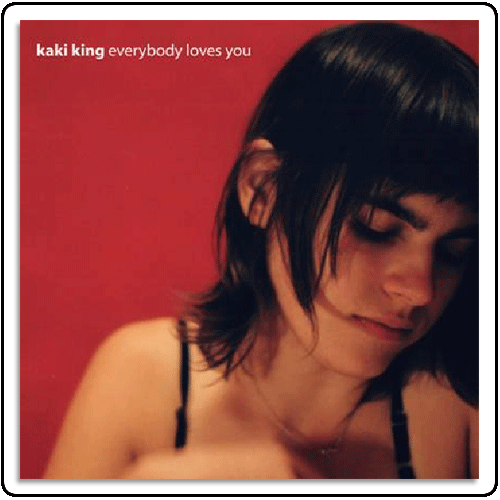
To start, this was her 10th anniversary show (or tour?). 10 years ago, she released, Everybody Loves You, to make money while playing in the subway. It caught, and the rest is history. But for this show, since it was the 10th anniversary, she played the album, start to finish.


And at first I was super excited when she mentioned that she was doing this; her first album is one of my favorites. After the first few songs, though, I was confused. Turns out I didn't have her first album. Later in the show, I would discover that I didn't have the second album either! Some fan I am? Actually, though, I'm excited because that means more new music of hers without having to wait for another "new" album ;)

But that left me coming to the table with no idea of how the songs should sound. Knowing her latest 4 albums, hearing the start gave insight into the makings of a musical genius. She told stories of her early struggles as a musician, rejection, playing drums for a band in college, and how this one little imperfect demo to sell in the subway blossomed into a career of 10 years and counting.

And Kaki really surprised me. Not that I didn’t expect her to rip; I just didn’t expect the personality. I had heard before that she was quieter and bitter/angsty. Maybe the report had come from a bad show? Everyone has them. But for this she was transparent. She was imperfect and made a few mistakes; she was quirky and stumbled over her words a few times. But she was genuine and she was having fun. When a world class musician can have a less than classically-inerrant performance, yet laugh, joke, and smile, it sets them apart from the mechanized and interjects soul and emotion. Kaki King had that.

And maybe it was because her family and friends were there? Some sisterhood banter to lighten the mood? Comfort from her wife? I don't know; I just know that it was just a good time; it felt like the intimacy of a house concert.

And I was somewhat afraid that after she played through the album that would be it. Instead, she finished up the album and started in on more. She ended up playing an hour and a half long set of just acoustic guitar. It was great.

Except there was more! Yes, a second set; 3 hours total. The second set was King with drummer, Jordan Perlson, and Dan Brantigan on the EVI (electronic valved instrument) and trumpet. For this, Kaki rose to her feet and dawned several other guitars (I think I counted 7 total for the evening) and a tenor(?) uke. Rather than sit, she stood in order to rock out a bit harder to some more of her newer material, mixed in with some of my old favorites off of ...Until We Felt Red. The second set also saw King’s voice transition from stories to singing. It played much more like a technically dazzling indie rock show.

Essentially, King had opened for herself and her band. Half dreamy acoustic music and half indie rock show, the sets were intertwined with the frenzied plucks, pats, and taps that set King's music into oceans of texture. Were there some slips here and there? Yes. Were there technical difficulties with the EVI? Yes. It’s not about hitting every note and having everything be technically flawless; mechanized music is lifeless. Music is about life; it’s about the breath of the instruments, how the artists interact with them, and how meaning can be drawn from feeling.

Kaki King nailed it. All I can think is how much it sucks that I missed her for YEARS and, prior to that, had missed this genre. I will now be locked in my guitar room for the foreseeable future (except for going to work and, perhaps, the bathroom).

And I'll leave you with this: another of my favorites, as well as King's encore -


Monday, January 14, 2013

Review: August Burns Red Presents: Sleddin' Hill

I tried.

As many of you know, I don't like Christmas music. Last year, I was blown away by Trevor Gordon Hall's Christmas album. I listened to it for probably about 2 months straight and still occasionally listen to it, nowhere close to Christmas time. It's better than that good. This year, I figured I'd give another Christmas album a  try. So I pre-ordered August Burns Red's, Sleddin' Hill.

I'm a long time ABR fan. My first show was their first show with Josh McManness, where Jon Hershey came out for one final song with the band. Since then, I've seen them at a number of different venues, probably numbering about 15 total shows. I'm even in their live DVD, Home.

So I wanted to like this. Leveler, out in 2011, was a pretty solid album. It showed progression. Still hard to stand up next to Thrill Seeker, but progression nonetheless. And that's what I wanted - something fresh and interesting.

And I got Christmas music.

I listened to this for weeks; it sat in my cars CD player as  I searched for something redemptive. At the end of every ride, however, I was left incredibly disappointed.

I think a few things played into this:
  • JB Brubaker has cited the album as showing a lot more punk influence than the typical ABR. Honestly, though, there is no discernible punk influence in any other ABR, so it doesn't tie well into the rest of their catalog. If they truely do enjoy punk, I get it, but I'm not a huge punk fan, so this did not sit well with me.
  • If you're going to do a punk album, make it punk. That means raw, unadulturated music. It doesn't have to sound like it has been recorded from a dilapidated garage on cheap guitars and cheap distortion pedals; mainly, it just needs to sound like you're seeing it live. This album, however, sounds sterile and over-produced. And compressed. Oh, how I loathe over-compression.
  • It's uncreative. The few originals they had are pretty solid tracks. They're inventive. The rest of the album is Christmas music. In order to succeed with a cover so vastly overdone, you have to reinvent the song; it can't just sound like frosty the snowman on speed.
  • The only vocals are on Rudolph the Red-Nosed Reindeer. It's in a punk-esque way, but just doesn't make me think ABR. They would have done better without. Either that, or I really wanted to hear some screaming through the whole album... That would be ABR.
Like I said, I'm unimpressed.

I wrote 90% of this review before Christmas. I didn't publish it until now, because I didn't want people to subject themselves to this prior to Christmas. I won't even link to it.

Now that Christmas is over, forget that ABR even did a Christmas album. Take a trip back in time and listen to Thrill Seeker.