Showing posts with label craigslist. Show all posts

Monday, August 22, 2011

Adamas 1881-NBBG 87


Adamas 1881-NBBG 87

I played an Adamas at Guitar Center a couple weeks ago. I wouldn’t have taken notice to it, but a few weeks prior I had done some research on Kaki King’s new signature Adamas. Considering she’s a percussive fingerstyle guitarist with hands that are probably the same size as mine, it seemed like it would be a good guitar to check out some day …when I have 2-3 grand just laying around.
So then I played the Adamas at GC. I had no clue what to expect. I don’t know anyone who owns an Adamas and I had no history of them. But I saw it there and saw a price tag on it: $1700.
Now you’ve gotta know something about Adamas to make that mean anything. Adamas is a branch of Ovation. And Ovation is notorious for making absolutely nothing special. Some people swear by them, but not many. Neat guitars, but more novelty to most. They’ve got this bizarre fiberglass bowl for a back rather than wooden sides/back and a lot of them also have weird soundholes. They also have a very distinguished headstock. Basically, they are extremely easy to spot.

At first they are intriguing, but after picking a few up, you’re not overly impressed. They generally don’t make anything above a low to mid ranged priced guitar. Not that price determines a lot, but when you’re looking at Taylors and Ayers, you the average Ovation does not catch your eye.
Naturally, when I saw what appeared to be an Ovation guitar with a $1700 price tag, I was rather befuddled. How? Why? Then I noticed the Adamas name. Sure, it was $1700, but a GC trip entitles you to play guitars out of your price range.
So I played the Adamas. It was great. Genuinely great. Then I left. The end?
Fast forward a couple weeks. I’m on Craigslist.
I’m rarely on because I want to buy something. Lately I have bought a lot off of it, but I’ve had a project of finishing my pedalboard and now that is done. Mostly though, CL is what keeps me informed on guitar equipment. Sure, it’s used stuff, but used gear has history. You find everything from vintage guitars that I’ve never heard of to boutique effect pedals that have a 12 month waiting list. It’s interesting to look around.
Then, around 2am, I see a post come up for an Adamas guitar. I look at it. Then look at the price (much less than the previous Adamas guitars mentioned). Then look at it again. Then look up Adamas guitars online to see some reviews/prices, etc.
I decide that I’ll check it out. If I buy it, I’ll sell some gear. The guitars stay, but other gear can be sold …mostly.
So I check it out the next day. Sure enough, it’s a winner.

Let’s go over some specifics:
The Neck:

There are a few different neck styles. The basics are your radius cuts (flat, thin profile), C shape (bulky and thick), V shape, and soft V shape. There are some variants of all of those, but that’s most of them. Of those, my guitars mostly resemble the radius cut necks. I don’t do bulky necks because my hands are small and the V shapes are just very uncommon.
The Adamas neck is an unfinished soft V. I’ve never played a soft V before. Since buying the guitar, I’ve compared it side by side to my Taylor. The Taylor has a nice thin neck with a satin finish. The two are as different as night and day. I’m very particular about the necks that I play (I won’t play Martins, Gibsons, Schecters, etc. because I don’t like the feel), but I have no preference one over the other with these two. Which is strange, because the Taylor neck is so amazingly smooth and fluid and the Adamas isn’t. But it feels so natural.

The Top:
There are many different types of materials that guitars can be made out of. Most of them are wood. Then you’ve got some electrics that have been made of acrylic and even a few made of aluminum. It’s only in the last few years that you’ve been able to easily find a guitar made of carbon fiber. They’ve been made for some 20 years, but have just been so rare that you never see them.
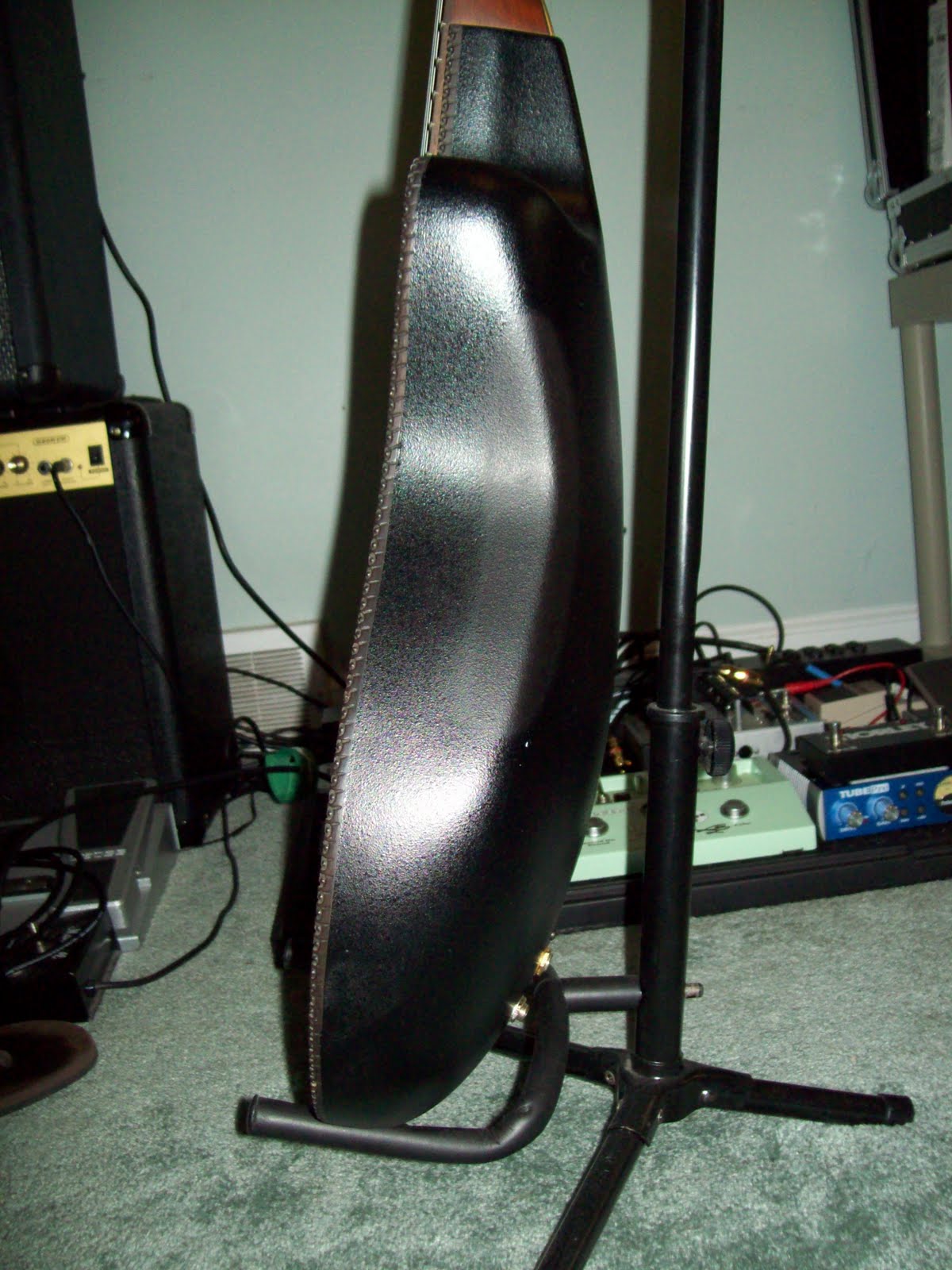
Yeah, this has a carbon fiber top.
Highly responsive and durable. It won’t break from any thumps, bumps, or nail hits. It has a very distinctly different sound from wood, but it still sounds good.
The Pickups:
I’m not sure whether it’s Ovation or Adamas specific, but they’ve got something wonderful going on inside of this. The pickup is actually the bridge, itself. The entire thing is a giant contact pickup. It’s interesting because of what the acoustic properties are like at that point. They should be tinny and shrill. However, they’ve got it balanced really well to give a nice full sound from each string.
Additionally, the previous owner did some experimentation with other pickups blended to give some more response from the body of the guitar. The ones in now are K&K piezo transducers. A LR Baggs Blender allows for blending the signal of the two different pickups to dial in on tone. I’m a fan.
As noted in my last post, this resulted in some damage to the bracing of the guitar. However, I’m going to fix it. The braces to repair it are in the mail right now. For FREE (see Customer Support (Ovation Guitars)). So the next 2 projects are pickups in the Taylor and braces for the Adamas. Busy week ahead.

Playing for the Blue Marsh Canteen Idol competition. I play in the final round October 5th.

EDIT-
The Taylor is done! Tonight I'll take the strings off of the Adamas to let the body adjust to the lack of tension, then I'll add in the new braces next week.

Monday, July 18, 2011

New to the Family

A few weeks ago, I embarked on yet another craigslist deal. As you may recall, months back I traded my Crate BV300 – a 300W all tube head. It was way more than I ever needed, especially with acoustic gigs. After trading that I was left with a Marshall 1960A 4x12 speaker cabinet. Sure, it sounds great and is a bit of an industry standard, but when did I ever use it and when was the last time I was looking at anything regarding the rock industry?
So it was time to give the cab a new home. I had tried many tactics before while trying to sell it on craigslist, but this time I posted it as a trade rather than for cash. And it worked.
There are now three new additions to my musical instrument family.
A cello that had been rescued from a school, a 1970 tele-star short-scale bass, and a 25 note chromatic wooden bell set. The plan is to be able to incorporate more instruments into my next album.


Note: the cello is missing a string because I may have been trying to tune the wrong string… A replacement is on its way and that will NOT happen again.
Perhaps I'll implement them into gigs as well? It’ll be a while before I can hack it as a cellist, but I can play bass and the bells wouldn’t be hard to do simple stuff with. I’ve got some piezo pickups that I can throw on the cello and the means to mic the bells. I’ll just have to check the response of my amp to see if it can go as low as a cello… Otherwise I’d be looking at a multiple amp setup …not that there’s anything wrong with that.

Tuesday, May 31, 2011

Graduating, Moving, and New Job

So here it is, the long awaited post on how drastically my life has changed over the past few weeks. This first post will be all of the changes. The post to follow this will be about what that means for my music.


It all began back in the fall of 2007. I had decided to go to Messiah College for Mechanical Engineering and was beginning my studies there. Move ahead about 4 years and my time at Messiah has come to a close and life just starts to go crazy.
 
I graduated a few weeks ago on May 14th. I had an interview set up with Alcon Labs, right outside of Reading, PA, where I basically already knew that I got the job. However, I was told it'd be a few weeks after my interview before I could start. After graduation I was supposed to have a nice relaxing few weeks to move out of my apartment, find a place to live, and move again.


Then comes the interview, Monday morning. Suddenly people are talking about having me start the following Monday. But it's alright. Kelly's (my girlfriend) dad works at the company and knows a guy with a huge house and a room he could rent to me.
 
But it's not alright. The guy is doing some house rennovations, installng centrail AC, so the whole house is torn up and won't be able to be lived in for quite some time. There's another guy who has a two bedroom apartment that I could rent a room from, but that's kinda cramped for me. I mean, I'm at 7 guitars right now. That takes up a lot of room - more room than a room in an apartment has.
 
So I hop on craigslist that night to look for something. I see a room for rent for a flat fee (covers utilities, cable, etc.) and decide to shoot the guy an email. 20 minutes later I get a call and the guy asks if I want to check it out that night. I check it out.
 
This place is pretty unbelievable. I didn't know there was a nice part of Reading until this. The neighborhood is in the +$250k range with a mansion thrown in here and there. So the house is pretty great with plenty of room for my guitars and even a hot tub. The guy is nice and his dog is too. It was what I was looking for in the time frame I was looking at, so then on Thursday, only a few days after finding the place, I moved in.
front of the house
some of the guitars and equipment

 
The following Monday, May 23rd, I started. Alcon is a pharmapseudical engineering company that works primarily with eyecare products. I'm currently working on a glaucoma shunt that's being brought over from Israel. You can see a video of it here (warning: graphic - it's an eye surgery).
 
Anyway, here's a broken down timeline:
May 14 - graduation
May 16 - interview
May 16 - find housing
May 19 - move
May 23 - start working
 
It's been crazy. I'm not sure what all this means for my music yet, but that will be explored more in the next post.

Monday, February 7, 2011

New Gear!!

As many of you know, I had a massive Crate BV300H guitar amp head. It was 300W of pure tube power. Obviously, as I only gig small venues with a primarily acoustic setup, this was a bit overkill and was left unused for quite some time. After trying to sell it for probably a bit over a year, I finally found a buyer on craigslist. As part of the deal, I got a Carvin Belair 50W Tube Combo amp. Here are some pictures:


The amp sounds amazing. It's got real glassy cleans and some nice grit in the "soak" channel. It's got a great vintage look and feel to it. I'm very pleased with the trade. If I had it more than 2 days, I'm sure I'd be able to add to the list of accolades, but a full review is a bit of a stretch for that little play.

In addition to looking and sounding awesome, it adds to a nice little pyramid of combo amps that I have started. On top is the Roland AC-60 that I normally gig with for it's acoustic voicing. In the middle is a Marshall G80R 50W combo that I got from my cousin over the summer. On the floor, you'll notice my Boss RC-20XL looping station, Danelectro Tape Reel Echo Simulator, and Boss GT-10. The GT-10 I got in the fall to replace my GT-3 and the Tape Reel Echo I just got a few weeks ago. The loop station and echo through the Belair is an amazing combination.

After seeing an add for the Boss GT-10 in a magazine a few days ago, I realized that it can also be used as a usb interface. Hopefully I'll be able to record with it in the near future, as soon as I find a spare Type B USB cable. There will definitely be more to come on this gear and more of my gear, as the collection expands.

-Alex

Thursday, February 3, 2011

Musical Experimentation Thoughts

As many of you are aware, I love experimental music. The whole percussive fingerstyle genre is essentially about pioneering what can be done with a guitar and coupling these efforts with marketable material, so it should be of no consequence that I often find myself thinking about how to do something new and innovative. While many of these ideas do not materialize themselves in the form of musical compositions, they are, at the very least, musings that are engaging and thought-provoking. The rest of this post will skim the surface of some of the endeavors which I have delved into and some of the ideas that I will be experimenting with. It is very likely that I will go into more detail with these techniques and ideas in a later post.

Prepared Instruments
Some of the more abstract experiments involve prepared instruments. To my knowledge, this is only done on stringed instruments - primarily pianos and guitars. Preparing an instrument involves adding or subtracting from the instrument something that ends up altering the sonic qualities of a note. In the case of pianos and guitars, there are very definite pitches which can be played as individual notes or together in chords. Common preparations involve wedging nuts or bolts between strings, paper-clipping strings together, damping the strings with something, etc. The end result may be anything from a slight alteration in pitch to a completely new, unique sound. In this way, preparations are done before playing the instrument and are done in a very precise, reproducible manner.

Sometime last spring I had the pleasure of seeing one of the finest guitar trios in the world, Guitar Republic. After seeing some of their work, which includes various preparation techniques, I was inspired to mess around with some prepared guitar. I was working mainly with paper clips, twist ties, and paper, but the possibilities are literally endless. I have yet to write anything for prepared guitar, but it is on my list of things to do.

Even before I had heard any prepared guitar, I was exposed to prepared piano by one of my roommates. John Cage pioneered prepared piano and, after listening to more of his work and looking at some of his music scores, I became interested in the art of preparing a piano. This was able to flesh itself out this past fall when I found a free piano on craigslist and brought it to school. Throughout the rest of the semester, during the composition lessons I had with Dr. Dwight Thomas, I prepared the piano. This spring I will be writing for prepared piano, alongside many other composition students. Here's a short clip of some of its sounds (understand that I don't play piano and this is merely for demonstration purposes):
Also, note that the piano has not been damaged in any way (I know that would freak some people out). I'll have a full post on the piano sometime soon...


Abstract Playing Techniques
By this, I mean techniques not seen traditionally. For instance, Henry Cowell's Banshee , where one pianist is playing inside of the piano, or Trace Bundy's percussive fingerstyle guitar compositions played with capos that are moved throughout the piece. These are the sort of things that inspire me. When I see someone do something like that, it floods my mind with all sorts of crazy ideas. This is actually what this post is about... So here are some innovative ideas pertaining to guitar:


  • Body Percussion: Especially with an acoustic guitar that is internally mic'd - this adds tons of possibilities to your compositions. Keep in mind that different parts of the body will give you different sounds. You can utilize the entire body, front and back to get a variety of different "drum" tones (I would advise against beating on the neck of the guitar, however, as that could really end up sucking). You can also vary the part of your hand that you're using. Try using your palm, the side of your thumb, your finger, rolling your knuckles, and even using your nails (if they're grown out).
  • String Percussion: The most common string percussion is made by slapping the strings against the fretboard after playing a chord. By simply slapping your palm down over the soundhole, you'll get a nice string slapping sound that will add texture to your music. This is also extremely easy to do and a good place to start. You can also get a similar sound by using individual fingers on your picking hand to make quick slaps on the fretboard across all of the strings. When this is done at a natural harmonic, you'll get what's known as a tapped harmonic. Try this out along with using 2 or 3 fingers individually on your picking hand in a rolling motion.
  • Playing Overtones: Whenever you do a hammer-on, you're actually producing more than one note. Obviously the note that you are fretting is primarily what you hear, but you are in between two fret wires, so you will get an overtone of the section of string above your finger as well. You will notice this more the further down the neck you travel. Beyond the 12th fret, if you are not muting the top half of the strings, you've probably heard this and it's probably been rather distressing if you are a tone seeker. Rather than freak out over this, experiment to use this to your advantage. By muting the strings above where you are fretting (a heavier palm mute will work), your hammer-ons will sound the otherwise obnoxious "overtone" section of the string. You can also fret normally and strum on the opposite side of the stings to get those tones.
    • Note: the action on your neck may cause a considerable amount of fret-buzz when you try this. Just get a new guitar (not that yours is insufficient, but I'm just giving a reasonable excuse to expand your collection).
  • Tune to the Headstock: I played a show once with a brilliant musician, Trevor Gordon Hall. Not that other people haven't done this, but one thing that I took note of was how well he incorporated the section of string at the headstock of the guitar. A month or so later and I found myself in my room, asking myself how I could do that better. I started experimenting and, as anyone who has done such a thing can attest to, the mix of tones up there sound horrid. It doesn't have to be, though. Just as you can change the tuning of the "playable" lengths of string to meet your needs, you can also tune the section on the headstock. You'll end up with some weird things going on with the normal section of strings, but that just gives you another challenge.


These are things that inspire me. I'd encourage everyone to play around with these and experiment. Music is much more than playing cover songs; it's an art that ought to celebrate creativity and innovation.

-Alex