Showing posts with label gear. Show all posts
Showing posts with label gear. Show all posts
Wednesday, September 11, 2013
New Headphones
Switching headphones. Not a big deal, right? I mean, it’s more a thing of comfort and style, right?
False. In this day and age, yes, comfort and style tend to take precedence over functionality, but what a shame it is that the main focus has fallen from the music. What a wonderful society we live in…
In reality, for those who care about music, the audiophiles to whatever degree you can afford, it’s about the sound quality. Always. Comfort is a thing of functionality, not to be wrapped up in the guise of style.
So you have headphones covering a vast gamut of the function/comfort/style continuum. I’d take studio monitors any day of the week, in an isolated room, but that’s not practical in all cases, unfortunately. So I’ve been stuck with a pair of original Apple earbuds for quite some time. You know, the ones that came out with ipods back in the day.
I’ve wanted a nice pair, maybe Sennheiser HD600s or 700s, for a while now. I heard some rave reviews from some audiophile icons, but I shouldn’t afford stuff like that. $400-$1000 for headphones? One of those things that you could do, but really, really shouldn’t. So I’ve resisted. But if you’re not going for gold, then what’s the point? I don’t like to upgrade in multiple iterations; I prefer to go for the best and then wait a long time until whatever gadget is more or less obsolete. I was the one who waited until a few months ago to hop on the smartphone bus, remember? I’m slow to change, but go all in when I do. So, while I’ve thought about an incremental step, something like Beats (of which I've heard mixed reviews for the price point), it just doesn’t make sense. And in that time, I’ve been stuck with earbuds.
When Apple came out with the ipod/earbud package, it was all about delivery. The sound quality wasn’t quite there and the earbud quality wasn’t quite there, but the package deal offered accessibility that was contagious. I waited a bit on the ipod, until I could buy a used 5th gen (better sound than those that followed) for $50 from a friend. And I got the earbuds to match. And, while I’ve upgraded the ipod to a bigger one (60GB up from 30GB, which still isn’t enough!), the earbuds have remained. Seriously, these things are like 8 years old!
But I recently got a smartphone. The HTC One, to be exact. And they came with headphones/earbuds; the nice kind with the silicone pieces that conform to your ears and act as passive noise-cancellers. Allegedly, these are, more or less, Beats, resembling them in nearly every way. However, they stayed in their package until last week …because I had my earbuds.
Then last week I opened them up to give them a try. I listened for an album or two and was impressed, but they didn’t fit right, so I left them sit. Well, today I just got out the other silicone ear pieces and found some that fit.
And the sound?! Oh my! I knew the earbuds were bad. I knew that I had been doing a disservice to good music. Maybe I was in denial? Maybe I was numb after seeing the $1000 price tag of the HD700s? Actually, that’s probably pretty close to it.
The difference is similar to the background noise I spoke of only days ago. I didn’t realize the richness I was missing. I mean, I knew, but I didn’t understand. It’s like a veil has been lifted.
The bass response is so much more defined. The thump of the bass drum and the low roar of the bass are resonant as never before. The highs are crisp without being tinny. They didn’t even sound tinny before, actually; now, in comparison, they do. And the mids are balanced. You can hear everything nearly as intended.
Which got me thinking… I mean, I did just release a new album. And, to be honest, I reviewed most everything on either my old earbuds or in my car. Rookie mistake, but, again, I didn’t want to pitch for the $1000 headphones to do the job “right.” But now I’m listening to the album. And …dang. The intricacies coming out are unbelievable. The fact that it’s a live recording is so much more apparent with the little artifacts founds throughout the background. This is nuts!
So I've followed with some of my other favorite albums/bands: Portishead's self titled, Between the Buried and Me's latest, This Will Destory You, Trevor Gordon Hall, and the list will go on. It's almost like rediscovering this music.
Yes, I could still pick these apart. They're still not quite the same as live, but that's not the point. The point is that these were so accessible and right under my nose! And these came with my phone, at no additional cost!
Which is making me think… how much better is the real deal? Yes, I’ll probably stick with these for the foreseeable future. And it will be without looking back. Seriously, it’s only been a few albums worth of listening so far, but I can’t see myself going back. And I’m more anxious than ever to move forward.


Monday, December 12, 2011
Studio Session 12/9-12/11
So I was just in the studio this past weekend and thought it’d be good to share some insight for those of you who may want to someday record some music and also for those who just want to know what it’s like. I’ll summarize my time this past weekend and throw in some tips as well.
Over three days (Friday-Sunday), I was at MR. STUDIO (Jeremy Bentley) in Lancaster for about 21 hours. In that time, I laid down guitar for 7 songs, totaling close to half an hour of material. These ranged in complexity from one or two track songs to some that had 6 or so. I’ll need to go in for one more day/weekend to finish up the project, but it is coming along well.
Overview:
Friday:
I tend to try to get the hard stuff out of the way first. It makes sense to me. So a song that uses two stages of looping, distortion, delay, and some crazy polyrhythmic stuff made sense. Between setup and this song, I ended up going over by an hour.
Saturday:
I started with some easier stuff on Saturday. Starting off with something straight forward made sense after Friday night’s work. After one easy one, I did one that had a bit more percussion involved, so it was a little more difficult to lay down and get dynamically correct.
Then I started on another complex one. Looping, reversed loops, distortion, delay, and surprises were all involved… And by surprises, I mean, you’ll have to wait and the wait will suck. In any event, this one took the cake for hardest. Some 6 hours later, both Jeremy and I were frustrated and didn’t have a complete recording.
Sunday:
Sunday started with an easier song that ended up with some extra goodies. I’m excited for this one. It didn’t take too long until I decided to start playing around with it. Then ideas just started popping up.
After that, I did an old one that really didn’t take much time at all. It was easy and straightforward. Then, one with some looping and some percussion that wasn’t too hard either. This one brought out some new ideas that drastically change how awesome the song will be, so playing around there took some time.
Finally, the song from Saturday was revisited. It took us up until the very end of the session, totaling somewhere between 7-8 hours on that one song… Frustrating, but a great final product.
Tips:
Guitars:
Get them professionally set up. This was the first time that my Taylor was set up (big thanks to Penn Avenue Music in Reading). I keep it in a pretty well controlled environment, so it wasn’t out too bad, but with the neck true, it plays noticeably smoother.
Restring your guitar. This will be done with the setup, unless you’re going to skip that step. Don’t experiment with a new type of string – use a gauge and brand that you are comfortable and familiar with. And break them in! No one wants a tinny sounding recording, so make sure you’ve got 20 hours or so on them.
Also, go into the studio with options. I never go in with just one guitar. This weekend, I only used one guitar, but I had another, as well as a bass, just in case I felt inspired. You don’t want to think up some great idea and not have the means to execute it. Sure, it sucks lugging tons of gear into the studio, but it sucks more when you want something that’s not there.
Electronics:
With acoustic, you generally just mic the guitar. You don’t use an amp, and, even with electrics, you want to avoid effects. The idea is that it is easier to add stuff later than it is to take it away. Ever try to take out reverb after it’s been recorded? Ha!
What you’re looking for with the electronics is that everything is working properly. This may mean a new set of tubes in your amp (or preamp, as was my case), isolating and eliminating any noise from your pedals, changing the battery in your guitar (for active p’ups), or servicing your vintage echoplex (mine needs to be cleaned). This will ensure that you’re not messing around trying to fix stuff during your studio time. When you do it there, it costs you money.
Practice:
You’re going to be playing your instrument for extended periods of time. And you’re going to be trying to get everything right the first time. So figure out what you want to play and then you’ve got two focal points: accuracy and endurance.
Accuracy is hitting every note correctly. In your practice time, focus not only on the right notes, but also on tone. At least with guitar, there are a number of different sounds you can get from the same note. You want the best one. So practice that way.
The endurance required may vary. For a solo instrumentalist such as myself, 20 hours in a studio means upwards of 20 hours playing guitar – in two or three days. If you’re in a band or also sing, you’ll have some relief. If not, you’ve gotta be prepared.
The first time I recorded with Jeremy, my fingers were raw after day one and I was in excruciating pain at the end of the weekend. I actually had to take time off of playing to let my hands recover. This time? My hands felt great at the end of every day and Sunday night, when I got home, I got out my guitar and started playing some more. The key was that leading up to the weekend, I put in quite a few 4-5 hour practice sessions, some on back to back days. Earlier I mentioned putting 20 hours on a new set of strings. I did that in a week. Including the time recording, I played for nearly 40 hours in a 7 day period. That’s a full week’s work.
Rest:
Don’t go in tired. Recording is mentally draining. Even if you are physically prepared, your mind needs to be in the game or you’ll get nothing done.
For vocalists, I hear you’re supposed to rest your voice. I don’t know, I’m not a vocalist.
Documentation:
This is a big engineering thing that has carried over to my music. I’ll never be one to write out my songs, but make sure you include any relevant details, so that you know them when you’re recording. This includes song names, tunings, effects used, effect settings, etc. I went a step beyond and made a chart that listed these things. Ultimately, it helped me to visually see which songs made sense in progression, giving me my album order. Sending this to Jeremy gave him a good idea of what was coming where as well. Be sure to keep track of anything that changes in the studio as well.
Be Open Minded:
Sure, I mentioned above that you want to have things figured out beforehand. The point there is that you shouldn’t be writing the songs on studio time. That doesn’t mean that they can’t change. Be open to changing things last minute. You may accidentally hit an extra note somewhere, but if it sounds better that way, then change it. When you’re sitting in a studio listening to the same section of a song a million times in a row, you’re bound to come up with some new ideas.
Let the Engineer Do His Thing:
These people record for a living. They probably know more about recording than you do. Accept that. Once I was in position with the mics, I was told not to move. Sure, I moved in between playing, but while playing I was in the exact same position EVERY TIME. Don’t screw that up.
Finally, here’s the gear setup that I used:
- · Guitar: Taylor 410ce (c. 2007)
- · Pickups: K&K Onboard Trinity
- · Effects: (in order) Presonus TubePRE (w/JJ 12ax7), Ernie Ball Volume Jr., Ibanez TS7, Line 6 DL4, Danelectro Tape Reel Echo Simulator, BBE Sonic Stomp, Fishman AFX Reverb, Boss RC20XL
- · Amp: Roland AC-60
- · Mics: (2) SM57 – 1 off of soundhole, 1 for amp. GT55 – off of 12th fret.
Monday, August 22, 2011
Adamas 1881-NBBG 87
Adamas 1881-NBBG 87

I played an Adamas at Guitar Center a couple weeks ago. I wouldn’t have taken notice to it, but a few weeks prior I had done some research on Kaki King’s new signature Adamas. Considering she’s a percussive fingerstyle guitarist with hands that are probably the same size as mine, it seemed like it would be a good guitar to check out some day …when I have 2-3 grand just laying around.
So then I played the Adamas at GC. I had no clue what to expect. I don’t know anyone who owns an Adamas and I had no history of them. But I saw it there and saw a price tag on it: $1700.
Now you’ve gotta know something about Adamas to make that mean anything. Adamas is a branch of Ovation. And Ovation is notorious for making absolutely nothing special. Some people swear by them, but not many. Neat guitars, but more novelty to most. They’ve got this bizarre fiberglass bowl for a back rather than wooden sides/back and a lot of them also have weird soundholes. They also have a very distinguished headstock. Basically, they are extremely easy to spot.

At first they are intriguing, but after picking a few up, you’re not overly impressed. They generally don’t make anything above a low to mid ranged priced guitar. Not that price determines a lot, but when you’re looking at Taylors and Ayers, you the average Ovation does not catch your eye.
Naturally, when I saw what appeared to be an Ovation guitar with a $1700 price tag, I was rather befuddled. How? Why? Then I noticed the Adamas name. Sure, it was $1700, but a GC trip entitles you to play guitars out of your price range.
So I played the Adamas. It was great. Genuinely great. Then I left. The end?
Fast forward a couple weeks. I’m on Craigslist.
I’m rarely on because I want to buy something. Lately I have bought a lot off of it, but I’ve had a project of finishing my pedalboard and now that is done. Mostly though, CL is what keeps me informed on guitar equipment. Sure, it’s used stuff, but used gear has history. You find everything from vintage guitars that I’ve never heard of to boutique effect pedals that have a 12 month waiting list. It’s interesting to look around.
Then, around 2am, I see a post come up for an Adamas guitar. I look at it. Then look at the price (much less than the previous Adamas guitars mentioned). Then look at it again. Then look up Adamas guitars online to see some reviews/prices, etc.
I decide that I’ll check it out. If I buy it, I’ll sell some gear. The guitars stay, but other gear can be sold …mostly.
So I check it out the next day. Sure enough, it’s a winner.

Let’s go over some specifics:
The Neck:

There are a few different neck styles. The basics are your radius cuts (flat, thin profile), C shape (bulky and thick), V shape, and soft V shape. There are some variants of all of those, but that’s most of them. Of those, my guitars mostly resemble the radius cut necks. I don’t do bulky necks because my hands are small and the V shapes are just very uncommon.
The Adamas neck is an unfinished soft V. I’ve never played a soft V before. Since buying the guitar, I’ve compared it side by side to my Taylor. The Taylor has a nice thin neck with a satin finish. The two are as different as night and day. I’m very particular about the necks that I play (I won’t play Martins, Gibsons, Schecters, etc. because I don’t like the feel), but I have no preference one over the other with these two. Which is strange, because the Taylor neck is so amazingly smooth and fluid and the Adamas isn’t. But it feels so natural.

The Top:
There are many different types of materials that guitars can be made out of. Most of them are wood. Then you’ve got some electrics that have been made of acrylic and even a few made of aluminum. It’s only in the last few years that you’ve been able to easily find a guitar made of carbon fiber. They’ve been made for some 20 years, but have just been so rare that you never see them.
Yeah, this has a carbon fiber top.
Highly responsive and durable. It won’t break from any thumps, bumps, or nail hits. It has a very distinctly different sound from wood, but it still sounds good.
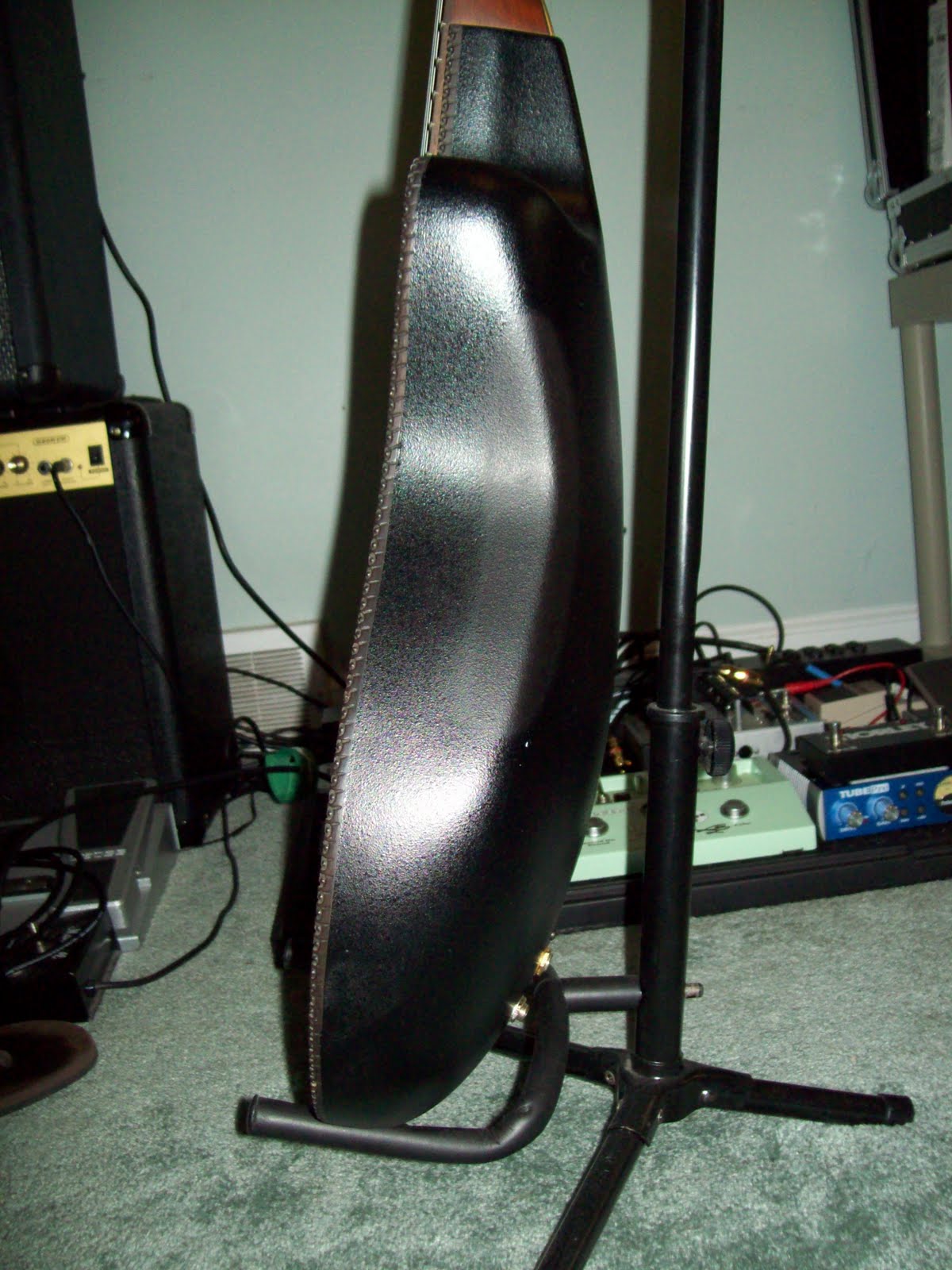
The Pickups:
I’m not sure whether it’s Ovation or Adamas specific, but they’ve got something wonderful going on inside of this. The pickup is actually the bridge, itself. The entire thing is a giant contact pickup. It’s interesting because of what the acoustic properties are like at that point. They should be tinny and shrill. However, they’ve got it balanced really well to give a nice full sound from each string.
Additionally, the previous owner did some experimentation with other pickups blended to give some more response from the body of the guitar. The ones in now are K&K piezo transducers. A LR Baggs Blender allows for blending the signal of the two different pickups to dial in on tone. I’m a fan.
As noted in my last post, this resulted in some damage to the bracing of the guitar. However, I’m going to fix it. The braces to repair it are in the mail right now. For FREE (see Customer Support (Ovation Guitars)). So the next 2 projects are pickups in the Taylor and braces for the Adamas. Busy week ahead.

 |
| Playing for the Blue Marsh Canteen Idol competition. I play in the final round October 5th. |
EDIT-
The Taylor is done! Tonight I'll take the strings off of the Adamas to let the body adjust to the lack of tension, then I'll add in the new braces next week.
Monday, July 18, 2011
New to the Family
A few weeks ago, I embarked on yet another craigslist deal. As you may recall, months back I traded my Crate BV300 – a 300W all tube head. It was way more than I ever needed, especially with acoustic gigs. After trading that I was left with a Marshall 1960A 4x12 speaker cabinet. Sure, it sounds great and is a bit of an industry standard, but when did I ever use it and when was the last time I was looking at anything regarding the rock industry?
So it was time to give the cab a new home. I had tried many tactics before while trying to sell it on craigslist, but this time I posted it as a trade rather than for cash. And it worked.
There are now three new additions to my musical instrument family.
A cello that had been rescued from a school, a 1970 tele-star short-scale bass, and a 25 note chromatic wooden bell set. The plan is to be able to incorporate more instruments into my next album.


Note: the cello is missing a string because I may have been trying to tune the wrong string… A replacement is on its way and that will NOT happen again.
Perhaps I'll implement them into gigs as well? It’ll be a while before I can hack it as a cellist, but I can play bass and the bells wouldn’t be hard to do simple stuff with. I’ve got some piezo pickups that I can throw on the cello and the means to mic the bells. I’ll just have to check the response of my amp to see if it can go as low as a cello… Otherwise I’d be looking at a multiple amp setup …not that there’s anything wrong with that.
Monday, February 7, 2011
New Gear!!
As many of you know, I had a massive Crate BV300H guitar amp head. It was 300W of pure tube power. Obviously, as I only gig small venues with a primarily acoustic setup, this was a bit overkill and was left unused for quite some time. After trying to sell it for probably a bit over a year, I finally found a buyer on craigslist. As part of the deal, I got a Carvin Belair 50W Tube Combo amp. Here are some pictures:


The amp sounds amazing. It's got real glassy cleans and some nice grit in the "soak" channel. It's got a great vintage look and feel to it. I'm very pleased with the trade. If I had it more than 2 days, I'm sure I'd be able to add to the list of accolades, but a full review is a bit of a stretch for that little play.
In addition to looking and sounding awesome, it adds to a nice little pyramid of combo amps that I have started. On top is the Roland AC-60 that I normally gig with for it's acoustic voicing. In the middle is a Marshall G80R 50W combo that I got from my cousin over the summer. On the floor, you'll notice my Boss RC-20XL looping station, Danelectro Tape Reel Echo Simulator, and Boss GT-10. The GT-10 I got in the fall to replace my GT-3 and the Tape Reel Echo I just got a few weeks ago. The loop station and echo through the Belair is an amazing combination.
After seeing an add for the Boss GT-10 in a magazine a few days ago, I realized that it can also be used as a usb interface. Hopefully I'll be able to record with it in the near future, as soon as I find a spare Type B USB cable. There will definitely be more to come on this gear and more of my gear, as the collection expands.
-Alex
Subscribe to:
Posts (Atom)